
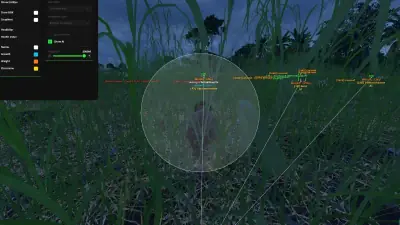
The Isle ESP: Species, Growth and Reading a Herd Before You Commit
Every marker in this game is a threat assessment. Species, growth and stamina decide the fight before it starts, and the filters decide whether you can read them.
An ESP in a shooter answers one question: where. In The Isle it has to answer four. What, how big, how tired, and is it alone.
Get the order wrong and the overlay is a wall of names. Get it right and it is the thing that stops you walking into an adult Tyrannosaurus at half growth.
Species first
Set species labels on before anything else and give them their own colour.
Evrima has a roster with wildly different threat profiles. A Hypsilophodon is prey. A Ceratosaurus is a fight. A Deinosuchus near water is a hard no. A Stegosaurus is a long grind you probably should not start.
Species text at 80 metres tells you which of those is coming.
Growth second, and it is the important one
Four stages: hatchling, juvenile, sub-adult, adult.
Growth is the single most useful field in the overlay and the reason a The Isle ESP is worth having at all. An adult of a small species and a sub-adult of a large one look similar in a box and are completely different fights.
Read growth with species. Adult Utahraptor: dangerous, fast, usually grouped. Juvenile Tyrannosaurus: big box, small stats, worth a try. Hatchling anything: free food if you can catch it.
Stamina third
Stamina is the escape bar and therefore the commitment bar.
A target with no stamina cannot run and cannot sustain a fight. A target with a full bar can do both. Health gets the attention and stamina decides the outcome.
Watch stamina on the one you are chasing, not on yourself.
Alone or grouped
There is no group count, so read the picture. Two adults of the same species within 20 metres of each other are a pair. Three or more is a herd and herds are how herbivores survive and how carnivore packs hunt.
Player direction helps here. Players facing each other are interacting. Players facing the same way are travelling together.
Distance
Cap it. 100 to 150 metres.
Evrima is dense and green, and at 250 metres every marker is a name floating over a bush with no decision attached. At 120 you get the ones you can reach before they move.
The max distance slider exists per layer. Use it per layer. Corpses at 40, water at 80, players at 120.
Corpses, gore and water
Corpses are food, and food is growth. Gore markers mean something died here and probably recently.
Water markers are survival and ambush at once. Every carnivore knows where the water is, so a water marker is also a warning.
Filters that keep it usable
NPC and animal off in open play. AI dinos are noise until you are hunting them.
Boxes or snaplines, not both. Snaplines help when you are new and clutter once you know the map.
Name on, health on, growth on, species on. That four is the threat read.
Head dot on. It gives the bite a consistent point.
Radar
Radar is the local picture when you cannot look away, mid bite or mid drink. Use it instead of boxes in a chase, where your eyes belong on the terrain.
Colours
Custom ESP colours per element, and this is worth ten minutes.
Species by threat band, not by species. One colour for prey sized, one for a fair fight, one for do not. Corpses a fourth. Water a fifth. If a Stegosaurus and a Hypsilophodon share a colour the palette is not doing its job.
What the ESP will not tell you
Mutations. A player with a defensive mutation can take more than the box suggests.
Whether they have seen you. Player direction is a hint, not a verdict.
Pack discipline. Some groups fight, some scatter. Growth tells you nothing about nerve.
Terrain. A marker behind a cliff is still a marker. You have to know the map.
A config
Open travel: players 120, species on, growth on, stamina on, corpses 40, water 80, NPC off.
Hunting: players 90, growth and stamina on, corpses 40, water off, radar on.
Save both. Change one thing at a time, and change it between lives rather than mid chase.